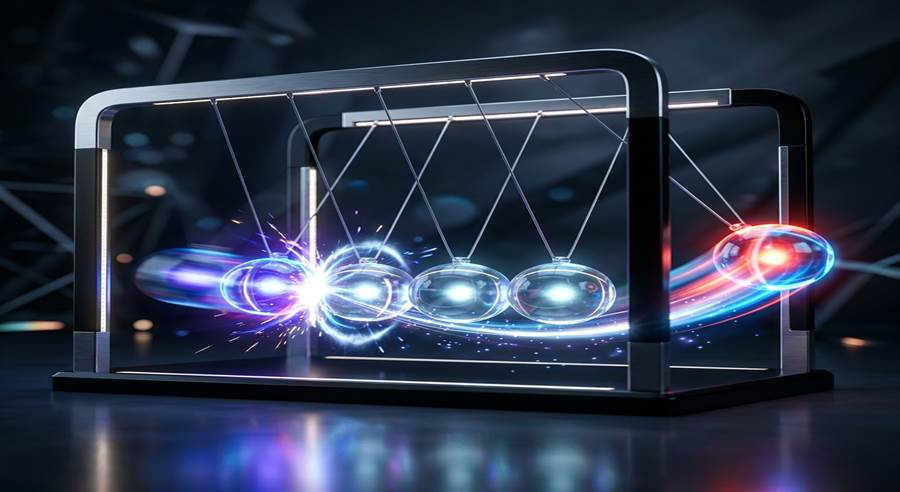
We’ve already talked about Isaac Newton and his famous apple incident when discussing gravity. But gravity was just a side quest for Newton. His real masterpiece was completely redefining how objects move.
The First Law: The Law of Laziness (Inertia)

The Human Translation: Stuff is incredibly lazy. If something is sitting still, it wants to stay sitting still forever. If something is moving, it wants to keep moving in a perfectly straight line forever. It takes an outside force to interrupt it.
You’re riding in a car at 60 mph, and the driver slams on the brakes. The car stops, but your body violently jerks forward. Why? Because your body was moving at 60 mph, and according to Newton’s First Law, it wants to keep moving at 60 mph until a force stops it. That force is your seatbelt.
The Second Law: The Heavy Couch Law (F=ma)

The Human Translation: Heavy things are harder to move than light things. And if you want something to move faster, you have to push it harder.
Imagine you have a shopping cart filled with just one box of cereal. You push it with one hand, and it zips down the grocery aisle with ease. Now, imagine filling that same shopping cart with 50 watermelons. If you push it with that exact same one-handed force, it’s barely going to move. Because the mass increased, the acceleration decreased.
The Third Law: The Karma Law (Action & Reaction)

The Human Translation: You can’t touch something without it touching you back with the exact same amount of effort.
This is precisely how rockets work in the vacuum of space. There is no air for a rocket to push against. So how does it move forward? The rocket engine violently blasts fire and gas out of the back (the action). The equal and opposite reaction is that the physical rocket itself is pushed violently forward.
Frictionless Motion

What makes Newton’s laws so spectacular is how universal they are. The exact same rules that dictate how a hockey puck slides across the frictionless ice are the exact same rules that dictate how galaxies collide in deep space.